
What pmsims does
pmsims estimates the minimum sample size needed to develop a prediction model to achieve a target level of performance with assurance. Rather than relying on simple rules of thumb or closed‑form formulae, pmsims uses simulation to:
- Generate synthetic datasets that reflect your target setting (outcome type, prevalence or \(R^2\), signal vs. noise predictors);
- Fit a specified model (e.g., logistic regression or linear regression);
- Evaluate a chosen performance metric (e.g., calibration slope, AUC); and
- Trace a learning curve of performance as the training size increases.
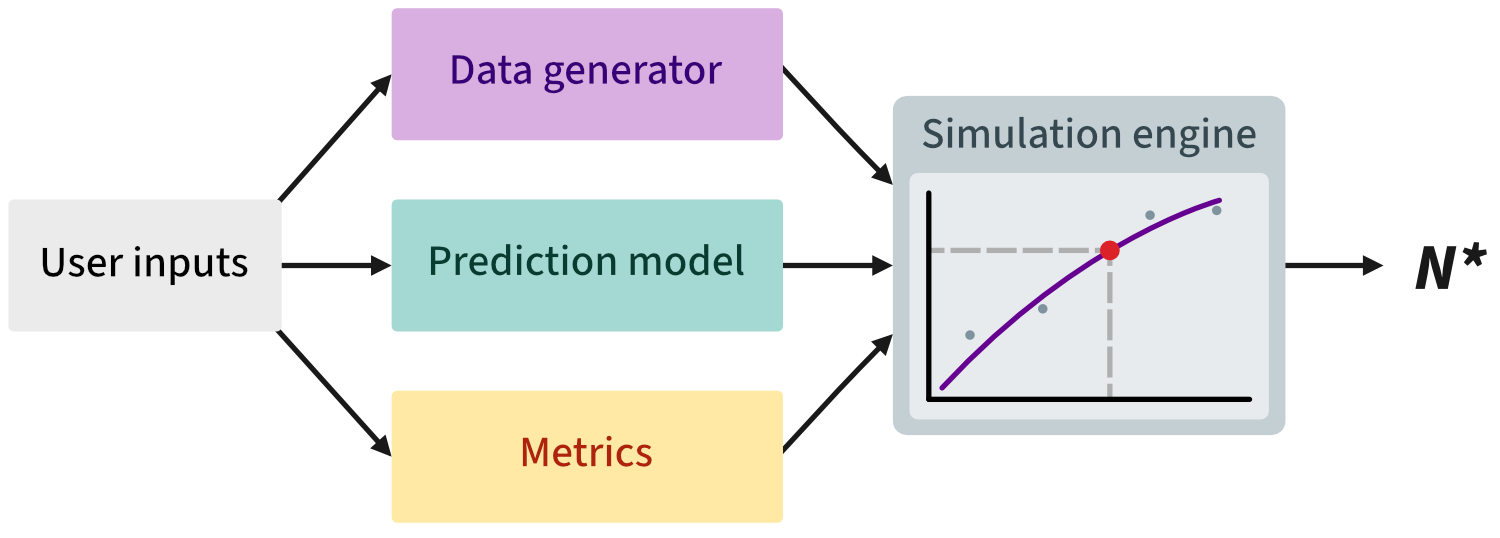
The recommended design objective is assurance: the smallest \(n\) such that a high proportion of repeated studies (e.g., 80%) meet the target performance. In pmsims, this is implemented via the 20th percentile of the simulated performance distribution at each \(n\).
Required inputs at a glance
There are three wrapper functions for binary, continuous, and survival outcomes, respectively:
All three functions share the same basic structure. The table below lists the key inputs.
| Argument | Description |
|---|---|
signal_parameters |
(int) Number of true signal predictors associated with the outcome. |
noise_parameters |
(int) Number of noise predictors unrelated to the outcome. |
predictor_type |
(chr) Type of simulated predictors ("continuous" or "binary").
|
binary_predictor_prevalence |
(num 0–1) Prevalence for binary predictors (used only if predictor_type = "binary").
|
outcome_prevalence |
(num 0–1) Target prevalence of the binary outcome. |
maximum_achievable_cstatistic |
(num 0–1) Maximum achievable C-statistic with effectively unlimited data. This calibrates the data generator and is not the minimum acceptable threshold. |
maximum_achievable_rsquared |
(num 0–1) Maximum achievable R2 with effectively unlimited data. This calibrates the data generator and is not the minimum acceptable threshold. |
maximum_achievable_cindex |
(num 0–1) Maximum achievable concordance index with effectively unlimited data. This calibrates the data generator and is not the minimum acceptable threshold. |
baseline_hazard |
(num > 0) Baseline hazard used by the survival data-generating mechanism. Larger values imply shorter event times, all else equal. |
censoring_rate |
(num 0–1) Proportion of individuals expected to be censored in the simulated survival datasets. |
model |
(chr) Model used for fitting (e.g. logistic, linear, or Cox). |
metric |
(chr) Performance metric used to estimate the minimum required sample size (e.g. calibration slope, R2, C-statistic). |
target_performance |
(num) Minimum acceptable performance in the units of the chosen metric (e.g. calibration slope ≥ 0.9), used as the threshold for selecting the required sample size. |
n_reps_total |
(int) Total number of simulation replications. |
mean_or_assurance |
(chr) Criterion for summarising results; "assurance" recommended.
|
Notes:
maximum_achievable_*represents the best plausible performance with effectively unlimited data and calibrates the data generator.target_performanceis the minimum acceptable performance threshold used to determine the required sample size.- For reproducibility, set a random seed (
set.seed()).
Binary-outcome example
We target the smallest n that meets the assurance criterion.
set.seed(123)

binary_example <- simulate_binary(
  signal_parameters = 20,
  noise_parameters  = 0,
  predictor_type = "continuous",
  binary_predictor_prevalence = NULL,
  outcome_prevalence = 0.30,
  maximum_achievable_cstatistic = 0.80,
  model = "glm",
  metric = "calibration_slope",
  target_performance = 0.85,
  n_reps_total = 1000,
  mean_or_assurance = "assurance"
)

binary_example
#> ┌────────────────────────────────────────┐
#> │ pmsims: Sample size simulation summary │
#> └────────────────────────────────────────┘
#> ──────────────────────────────────── Inputs ────────────────────────────────────
#> Outcome : binary
#> Predictor type : continuous
#> Number of predictors : 20
#> Noise predictors : 0
#> Prevalence : 0.3
#> Expected large-sample performance : C-statistic ('cstatistic') = 0.800
#> Target for chosen performance metric : Calibration slope ('calib_slope') = 0.850
#> Model : glm
#> Simulation reps : 1,000
#> ──────────────────────────────────── Results ───────────────────────────────────
#> Final minimum sample size : 1,044
#> Estimated performance at N : 0.849 (Calibration slope ('calib_slope') = 0.850)
#> Estimated other metric at N : 0.782 (Auc ('auc'))
#> Model : glm
#> Mode : Assurance
#> Running time : 2 minutes 39 seconds
#> Assurance mode ensures the target metric is met with high probability across repeated datasets.Plot the estimated learning curve and identified sample size:
plot(binary_example)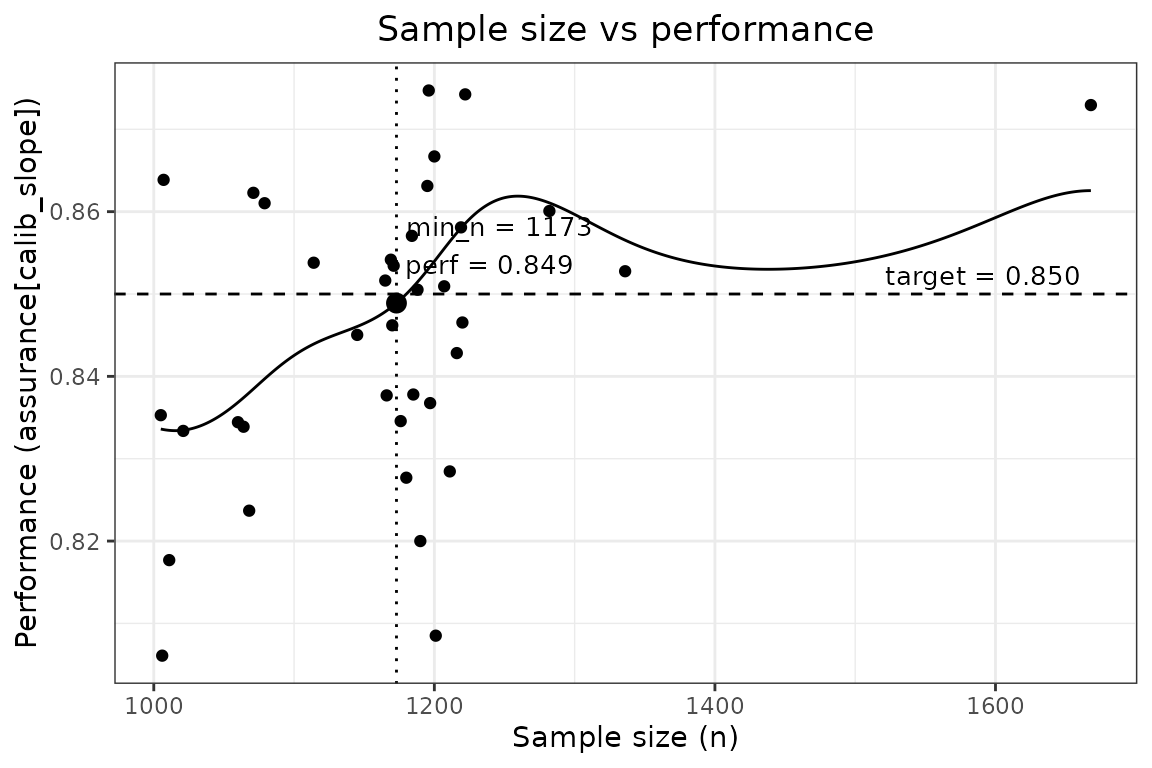
Continuous-outcome example
continuous_example <- simulate_continuous(
  signal_parameters = 15,
  noise_parameters = 0,
  predictor_type = "continuous",
  maximum_achievable_rsquared = 0.50,
  model = "lm",
  metric = "calibration_slope",
  target_performance = 0.90,
  n_reps_total = 1000,
  mean_or_assurance = "assurance"
)

continuous_example
#> ┌────────────────────────────────────────┐
#> │ pmsims: Sample size simulation summary │
#> └────────────────────────────────────────┘
#> ──────────────────────────────────── Inputs ────────────────────────────────────
#> Outcome : continuous
#> Predictor type : continuous
#> Number of predictors : 15
#> Noise predictors : 0
#> Expected large-sample performance : R² ('r2') = 0.500
#> Target for chosen performance metric : Calibration slope ('calib_slope') = 0.900
#> Model : lm
#> Simulation reps : 1,000
#> ──────────────────────────────────── Results ───────────────────────────────────
#> Final minimum sample size : 239
#> Estimated performance at N : 0.900 (Calibration slope ('calib_slope') = 0.900)
#> Estimated other metric at N : 0.486 (R2 ('r2'))
#> Model : lm
#> Mode : Assurance
#> Running time : 52 seconds
#> Assurance mode ensures the target metric is met with high probability across repeated datasets.
plot(continuous_example)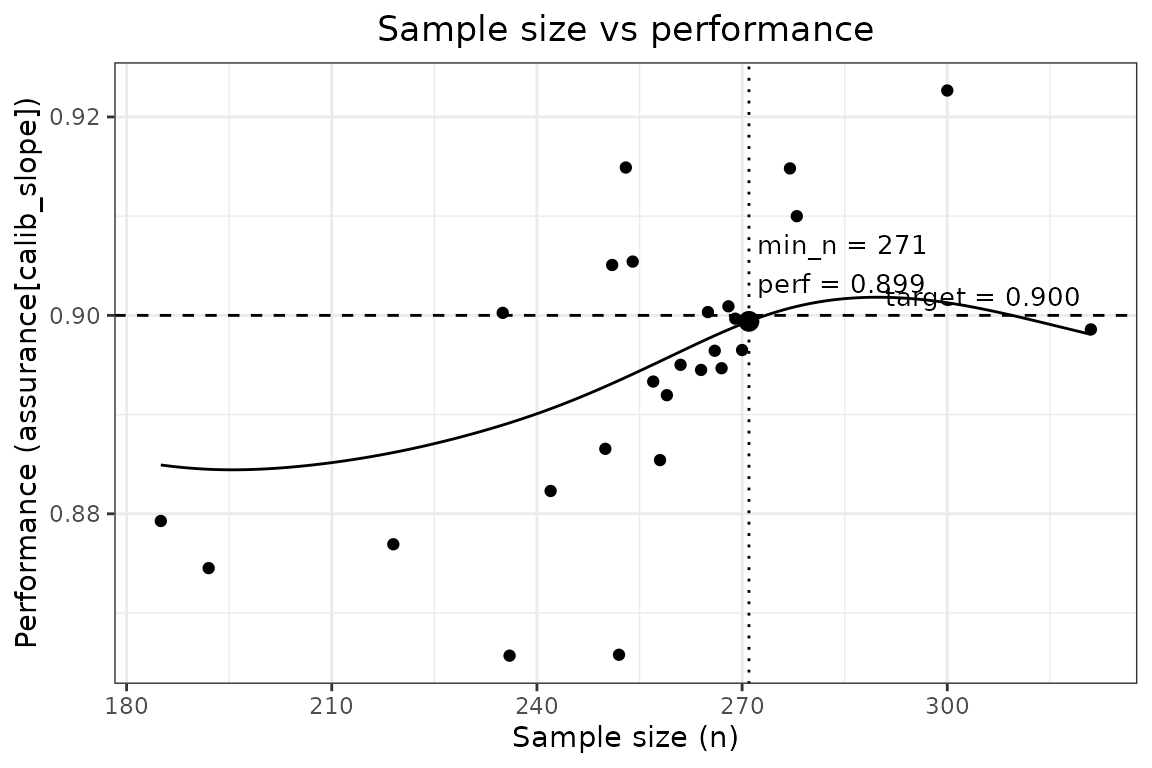
Session info
sessionInfo()
#> R version 4.6.0 (2026-04-24)
#> Platform: x86_64-pc-linux-gnu
#> Running under: Ubuntu 24.04.4 LTS
#>
#> Matrix products: default
#> BLAS:   /usr/lib/x86_64-linux-gnu/openblas-pthread/libblas.so.3
#> LAPACK: /usr/lib/x86_64-linux-gnu/openblas-pthread/libopenblasp-r0.3.26.so;  LAPACK version 3.12.0
#>
#> locale:
#>  [1] LC_CTYPE=C.UTF-8       LC_NUMERIC=C           LC_TIME=C.UTF-8
#>  [4] LC_COLLATE=C.UTF-8     LC_MONETARY=C.UTF-8    LC_MESSAGES=C.UTF-8
#>  [7] LC_PAPER=C.UTF-8       LC_NAME=C              LC_ADDRESS=C
#> [10] LC_TELEPHONE=C         LC_MEASUREMENT=C.UTF-8 LC_IDENTIFICATION=C
#>
#> time zone: UTC
#> tzcode source: system (glibc)
#>
#> attached base packages:
#> [1] stats     graphics  grDevices utils     datasets  methods   base
#>
#> other attached packages:
#> [1] pmsims_0.5.0
#>
#> loaded via a namespace (and not attached):
#>  [1] Matrix_1.7-5       gtable_0.3.6       jsonlite_2.0.0     compiler_4.6.0
#>  [5] crayon_1.5.3       jquerylib_0.1.4    splines_4.6.0      systemfonts_1.3.2
#>  [9] scales_1.4.0       textshaping_1.0.5  yaml_2.3.12        fastmap_1.2.0
#> [13] lattice_0.22-9     ggplot2_4.0.3      R6_2.6.1           labeling_0.4.3
#> [17] knitr_1.51         htmlwidgets_1.6.4  desc_1.4.3         bslib_0.11.0
#> [21] RColorBrewer_1.1-3 rlang_1.2.0        cachem_1.1.0       xfun_0.58
#> [25] fs_2.1.0           DiceKriging_1.6.1  sass_0.4.10        S7_0.2.2
#> [29] otel_0.2.0         cli_3.6.6          pkgdown_2.2.0      withr_3.0.2
#> [33] digest_0.6.39      grid_4.6.0         lifecycle_1.0.5    mlpwr_1.1.1
#> [37] vctrs_0.7.3        evaluate_1.0.5     glue_1.8.1         farver_2.1.2
#> [41] ragg_1.5.2         survival_3.8-6     rmarkdown_2.31     tools_4.6.0
#> [45] htmltools_0.5.9